July 10, 2026
Menopause Isn’t the Diagnosis – Hormone Deficiency Is
“I don’t feel like myself anymore.”
It’s one of the most common things women say when they begin experiencing hormonal changes.
Maybe you’ve gained weight despite eating the same way you always have. You’re exhausted even after a full night’s sleep. Your workouts aren’t producing results. Your patience is shorter. Your memory feels foggy. Intimacy isn’t what it used to be. And somewhere along the way, you’ve started wondering if this is simply what aging feels like.
For many women, the answer they receive is surprisingly simple:
“It’s just menopause.”
But what if that explanation doesn’t tell the whole story?
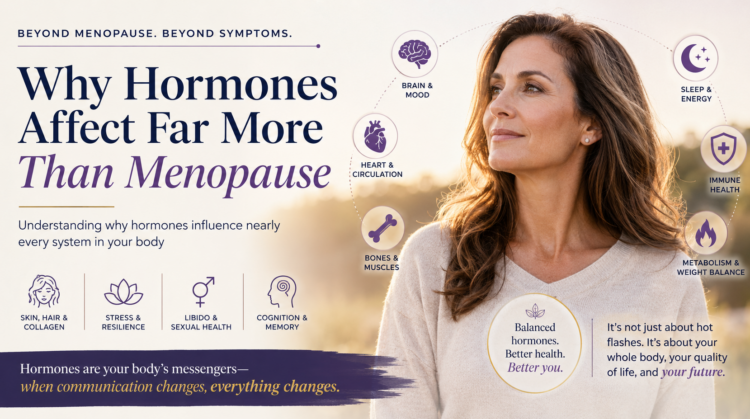
At Hormonify, we believe one of the biggest misconceptions in medicine is that hormones only matter when it comes to hot flashes, periods, or fertility. In reality, hormones influence nearly every system in the body. Understanding that connection is often the first step toward understanding why you don’t feel like yourself—and what may be contributing to those changes.
When most people hear the word hormones, they immediately think of menopause.
Hot flashes.
Night sweats.
Mood swings.
While these symptoms certainly can be related to hormonal changes, they’re only a small part of a much larger picture.
Hormones are chemical messengers. They travel through your bloodstream, delivering instructions that help your organs communicate with one another. Every minute of every day, they help regulate processes that most of us never think about—from maintaining bone strength and muscle mass to supporting sleep, memory, metabolism, skin health, sexual wellness, and even how our brains respond to stress.
When hormone levels begin to change, the effects often extend far beyond the reproductive system.
Imagine your home Wi-Fi suddenly becomes unreliable.
Your television buffers.
Your laptop disconnects.
Your phone struggles to load websites.
Your smart thermostat stops responding.
Nothing is actually broken. The devices still work—they’re simply no longer receiving the signals they need.
Hormones function in a remarkably similar way.
Think of them as your body’s communication network. They allow your brain, adrenal glands, ovaries, muscles, bones, immune system, and other organs to stay connected and work together.
When hormone production changes, that communication can become less efficient. The result isn’t usually one isolated symptom. Instead, multiple systems begin showing signs that something has changed.
This is why someone may experience fatigue, poor sleep, weight changes, low motivation, dry skin, decreased libido, or brain fog all around the same time. While these symptoms can have many possible causes, hormonal changes are one possibility that deserves thoughtful evaluation.
One of the biggest misunderstandings surrounding hormone health is the idea that a single hormone is responsible for everything.
For years, conversations about menopause focused almost entirely on estrogen. However, hormones operate as an interconnected system rather than individual players working independently.
Each hormone contributes to overall health in different ways.
Progesterone plays an important role in reproductive health and may influence sleep quality and nervous system function.
Estrogen supports bone health, skin, vaginal tissue, cardiovascular health, and brain function.
Testosterone, although often associated with men, is also naturally produced by women and contributes to muscle strength, motivation, energy, and sexual desire.
DHEA, produced primarily by the adrenal glands, serves as a precursor hormone and may play a role in energy, resilience, and healthy aging.
Rather than acting independently, these hormones work together in a carefully balanced system. When one hormone changes, others may be affected as well.
Hormone deficiency doesn’t always announce itself with obvious symptoms.
Instead, many people describe feeling like something is “off.”
They may say:
Individually, these symptoms might seem unrelated. Together, they may suggest that it’s worth looking at the bigger picture.
It’s important to remember that many medical conditions—including thyroid disorders, nutritional deficiencies, sleep disorders, chronic stress, depression, and other health concerns—can produce similar symptoms. That’s why a comprehensive medical evaluation is essential.
Dr. Edward Eckert has spent decades studying hormone replacement therapy and believes that terms such as perimenopause and menopause describe stages of life—but don’t necessarily explain why a person is experiencing symptoms.
Instead of focusing solely on labels, his clinical philosophy centers on asking a different question:
Which hormones, if any, are no longer being produced at optimal levels?
That subtle shift changes the conversation.
Rather than assuming every woman experiences hormonal changes in exactly the same way, this approach recognizes that every person is unique. Hormone production varies from individual to individual, and symptoms may develop differently depending on which hormones are changing and to what degree.
For this reason, individualized assessment is a cornerstone of personalized hormone care.
One analogy Dr. Eckert often uses compares hormone replacement with insulin therapy for people with diabetes.
The goal isn’t to “treat menopause.”
The goal is to identify whether a deficiency exists and determine whether replacing what the body is no longer producing may help restore balance.
Whether or not hormone therapy is appropriate depends on many factors, including medical history, symptoms, laboratory testing, age, and individual health goals. A personalized evaluation helps determine what approach is safest and most appropriate for each patient.
For many people, hormone health isn’t simply about eliminating hot flashes or improving sleep.
It’s about maintaining quality of life.
Healthy muscles.
Strong bones.
Mental clarity.
Energy to exercise.
Confidence.
Healthy relationships.
The ability to enjoy life.
As we age, these become increasingly important. While no therapy can stop the aging process, understanding the role hormones play in overall health can help individuals make informed decisions alongside their healthcare provider.
Hormones influence far more than reproduction.
They help coordinate communication between nearly every major system in the body, affecting how we sleep, think, move, recover, and feel.
If you’ve been experiencing persistent fatigue, brain fog, mood changes, declining energy, poor sleep, weight changes, or decreased libido, it’s worth remembering that these symptoms are not always isolated problems. They may share common underlying contributors, including hormonal changes.
The first step isn’t assuming hormones are the answer.
The first step is asking the right questions.
Because understanding why you don’t feel like yourself is often the beginning of feeling better.
At Hormonify, we believe every patient deserves more than a quick prescription—they deserve answers. Our approach focuses on understanding the whole person through comprehensive evaluation, education, and individualized care. By identifying potential hormone imbalances and developing personalized treatment strategies when appropriate, our goal is to help patients regain energy, confidence, and quality of life through informed, evidence-based care.
You can book a Free Pre Consultation at https://Hormonify.com | Call 954-427-7179
Next in our Hormone Education Series: Menopause Isn’t the Diagnosis—Hormone Deficiency Is: Why the Labels Don’t Tell the Whole Story.